
Richard Blackett
Pen Name
R.J.M BLACKETT



Latest Publish
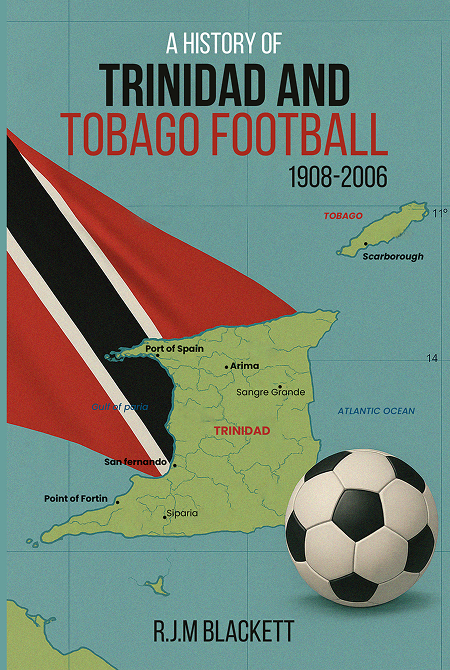
A History of Trinidad and Tobago Football, 1908–2006 traces the game’s journey from its colonial roots
R.J.M. Blackett traces the rise of football from humble colonial beginnings to a defining force in national pride. This is not just the history of a sport. It is the story of identity, ambition, and a country that dared to dream big.

Watch The Video
Know More

A History Of
Trinidad AND
Tobago Football
1908-2006
A History of Trinidad and Tobago Football (1908–2006) by R.J.M. Blackett is a comprehensive and compelling account of how football evolved from a colonial pastime into a defining element of national identity. Spanning nearly a century, the book documents the formation of early clubs, the growth of local competitions, and the social forces that shaped the sport’s development. Through detailed research, archival records, and cultural analysis, Blackett explores how football reflected broader issues of race, class, politics, and community life in Trinidad and Tobago. The narrative builds toward the country’s historic qualification for the 2006 FIFA World Cup, a milestone that symbolized decades of persistence and ambition. More than a sports history, this book preserves a vital part of the nation’s heritage, offering readers insight into how passion, resilience, and unity transformed football into a powerful symbol of pride and possibility.
Richard Blackett
R.J.M. Blackett is a historian with deep personal and intellectual ties to Trinidad and Tobago. Growing up near the Queen’s Park Savannah, the birthplace of organized football in the country, he witnessed firsthand the cultural importance of the sport.
Birth
1971
Motivated by the absence of a comprehensive history of football in Trinidad and Tobago, Blackett undertook extensive archival research, conducted interviews with former players and administrators, and examined decades of newspaper records.



- Awards


Have Questions? Find Answers Here!
Who is this book written for?
This book is perfect for football fans, history lovers, students, researchers, and anyone who feels connected to Trinidad and Tobago’s cultural journey. You do not need to be a sports expert to enjoy it. If you appreciate stories about resilience, national pride, and community spirit, you will find this book meaningful and inspiring. It speaks to both passionate supporters and curious readers who simply want to understand how football shaped a nation.
Is the book only about matches and scores?
Not at all. While important games and tournaments are covered, the heart of the book lies in the people behind the sport. It explores players, administrators, communities, and the social environment that influenced football’s growth. Readers gain insight into how issues like race, class, politics, and identity were reflected through the game.
What makes this book different from other sports histories?
Many sports books focus mainly on statistics and famous victories. This work goes deeper. R.J.M. Blackett combines careful archival research with storytelling, creating a narrative that feels alive and personal. It connects football to the wider historical and cultural development of Trinidad and Tobago, making it both educational and emotionally engaging.
Does the book cover the 2006 World Cup journey?
Yes, and it does so with context and depth. The book traces decades of effort, near misses, and determination that led to qualification for the 2006 FIFA World Cup. Readers understand why that achievement meant so much — not just as a sporting milestone, but as a powerful national moment.
What inspired the author to write this book?
The author recognized that much of Trinidad and Tobago’s football history was scattered across newspapers, archives, and personal memories. He wanted to preserve those stories before they were lost. His goal was to document the sport’s journey in a way that future generations could appreciate and learn from.
How can other authors benefit from reading this book?
Writers interested in historical or sports-based projects can learn how to organize research, develop strong narrative flow, and balance facts with storytelling. The book demonstrates how to transform archival materials and interviews into a cohesive and compelling publication.
What are Richard Blackett’s notable works?
R.J.M. Blackett is a leading historian of African-American history, slavery, and abolition. His acclaimed books, including Samuel Ringgold Ward: A Life of Struggle (2023), The Captive’s Quest for Freedom (2018), and Making Freedom: The Underground Railroad and the Politics of Slavery (2013), explore the lives of fugitive slaves, abolitionists, and African-American leaders. Through his research, Blackett sheds light on the struggles for freedom, justice, and human dignity in 19th-century America and the transatlantic world. His work combines meticulous scholarship with compelling storytelling, offering deep insight into the history of slavery, resistance, and transatlantic connections.
What makes Richard Blackett uniquely qualified to write this book?
Richard Blackett combines academic discipline with personal connection. Having grown up close to the historic Queen’s Park Savannah, where organized football in Trinidad began, he developed an early appreciation for the sport’s cultural importance. His extensive research, use of archival materials, and interviews with former players and administrators give the book both credibility and authenticity.